

In Kentucky, the demand for afterschool programs is incredibly high, but just a fraction of families have access. We’re working to change that by putting actionable data on Kentucky’s program landscape in the hands of decision-makers and the public.
Overview
Decades of research show that afterschool and summer learning programs make good economic sense and have long-term benefits on learning, safety, and family well-being.
Every $1 invested in afterschool programs alone saves at least $3 by:
- Increasing kids’ learning potential
- Improving kids’ performance at school
- Reducing crime and juvenile delinquency
But over the past decade, participation has shrunk despite demand remaining high.
Afterschool by the Numbers in Kentucky
Source: Kentucky After 3PM 2025
Parents of 346,276 children and youth in Kentucky want them in an afterschool program, but approximately 5 in 6 of these children are missing out.
56,940
Number of children in afterschool programs
289,335
Number of children without access to a program
4.9
Average hours per week
3.9
Average days per week
$115.80
Average cost per child per week
Among parents who pay for afterschool programs
87%
Percent of parents in favor of public funding for afterschool opportunities
Program affordability, accessibility, and availability limit participation.
Program Landscape
Many groups and organizations provide afterschool and summer learning programming.
In Kentucky, these may include:
- 4-H
- Boys & Girls Clubs of America
- Cities/towns, including Parks and Recreation Departments)
- Colleges and universities
- Community-based organizations (CBOs)
- Faith-based organizations
- Girls Inc.
- Libraries
- Licensed child care centers (includes YMCA school-age child care programs)
- Museums, zoos, and science centers
- Nonprofit or charitable organizations
- Private K-12 schools
- Private organizations
- Public K-12 schools and districts, including Family Resource and Youth Services Centers (FRYSCs)
Our maps below focus on Kentucky’s federally funded 21st Century Community Learning Centers (21st CCLCs) and regulated programs.
21st Century Community Learning Centers
The Nita M. Lowey 21st Century Community Learning Centers (21st CCLC) initiative is the only federal funding source dedicated exclusively to supporting local afterschool, before-school and summer learning programs. Each state receives funds based on its share of Title I funding for low-income students. Funding is awarded through a competitive grant process to local schools and community-based organizations (CBOs) that provide afterschool and summer learning programming to students attending high-poverty, low-performing schools. In Kentucky, the program serves approximately 30,000 low-income youth each year.
According to a 2023 evaluation of 21st CCLCs in Kentucky, students with regular attendance saw positive gains in their engagement in school and academic achievement. However, demand for programming in Kentucky is so great that nearly 1 out of every 2 applications was not funded during the most recent competition. As a result, less than 20% of all Title I schools in Kentucky have access to federal 21st CCLC funding.
Map 1: Kentucky’s Supply of 21st Century Community Learning Centers During the 2023-2024 School Year
Zoom in to view additional locations. Hover over each location to view additional information.

Regulated School-Age Child Care
A robust child care system that provides a continuum of high-quality care from infancy through school age is essential for meeting the needs of kids and families today. That system includes afterschool, summer, and other school-age child care programs that serve children ages 5-12 when school is out. Yet, Kentucky has never had enough programs to serve all the families needing them. Currently, 79 of Kentucky’s 120 counties (66%) are considered childcare deserts, meaning that they do not have enough child care to meet demand. Rural counties located far from major interstates and population centers are most likely to be classified as childcare deserts.
Low-income families in Kentucky who meet eligibility requirements may receive Child Care Assistance Program (CCAP) subsidies to cover the cost of care for children up to age 13, or age 19 with a documented special need. However, critical school-age child care supply shortages prevent many eligible families from enrolling their child(ren) in a program. In 2024, 11 counties had no regulated school-age child care.
Map 2: Kentucky’s Regulated School-Age Child Care Supply in 2024
Hover over the map to view additional information.

Permitted Youth Camps
Youth camps in Kentucky are permitted by the Kentucky Cabinet for Health and Family Services Environmental Management Branch. Both day and overnight camps require permitting. Child care licensing requirements may also apply to some types of camps. Permits are issued and inspections are carried out by local health departments. Camps must also meet food preparation and service standards, Kentucky building codes, federal flammability standards, and more. Some camps are also accredited by the American Camping Association (ACA).
Over 150 camps across Kentucky unlock new opportunities for young people each year while ensuring they are safe, supported, and engaged during the summer months. While some camps offer scholarships and other types of financial assistance to help families afford camp, a growing number of children, especially those from low-income households, are without access each year. In 2022, the ACA reported that the average cost of day camp more than doubled to $178 per day, compared to $76 per day in 2021. For sleepaway camp, the average cost nearly tripled.
Map 3: Kentucky’s Permitted Youth Camp Supply in 2024
Hover over the map to view additional information.

Use the 2020 Census Demographic Data Map Viewer to access relevant demographic data at multiple geographic levels.
Afterschool Works
Decades of research show that targeted investments in afterschool and summer learning programs make good economic sense and benefit everyone by:
When parents worry about what their kids are doing after school, it makes it hard for them to work — meaning U.S. businesses can lose up to $300 billion a year! Afterschool and summer programs help parents focus on their jobs so businesses can thrive.
Among Kentucky parents:
- 83% agree that afterschool programs help them keep their jobs or work more hours.
- 90% agree that afterschool programs help boost productivity at work.
In Kentucky, chronic absenteeism is at an all-time high while scores on national assessments of reading and math proficiency have declined over the past decade.
Students who regularly participate in quality afterschool and summer programs:
- Raise reading levels and increase math scores.
- Improve their school attendance, work habits,
and grades. - Are more likely to graduate.
Afterschool and summer programs help students gain real-world work experience and build the soft skills employers crave like teamwork, communication, and critical thinking.
Among Kentucky parents:
- 87% agree that programs help kids build social skills and responsible decision-making.
- 86% agree that programs boost kids’ teamwork, critical thinking, and leadership skills.
Afterschool and summer programs keep kids and communities safe by helping them make smart choices and stay away from risky activities – both online and offline.
Among Kentucky parents:
- 77% agree afterschool programs keep kids safe.
- 86% say afterschool programs encourage fun and learning, decreasing screen time.
Thank you to our partners.
Because no single source of data exists that completely captures all OST programs in Kentucky, we collect lists and other data from multiple sources to provide the public with the most comprehensive up-to-date information on Kentucky’s OST program landscape. We are especially grateful to the Kentucky Cabinet for Health and Family Services (CHFS) and the Kentucky Department of Education for making this project possible.
Learn More
Want to know more? Use the links below to explore a selection of the latest research from us and our partners.
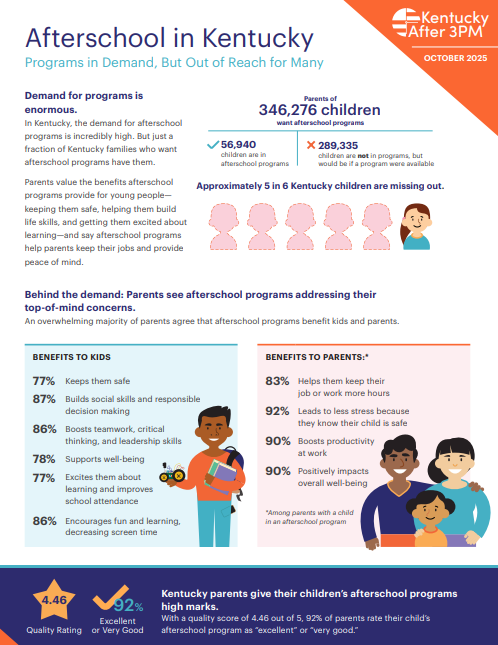
Afterschool in Kentucky: Programs in Demand, But Out of Reach for Many (October 2025)
This October 2025 fact sheet from the Afterschool Alliance highlights Kentucky’s latest America After 3PM findings, showing that while parents overwhelmingly value afterschool programs for their benefits to children and families, five in six Kentucky youth who want programs can’t access them due to cost, availability, and transportation barriers.
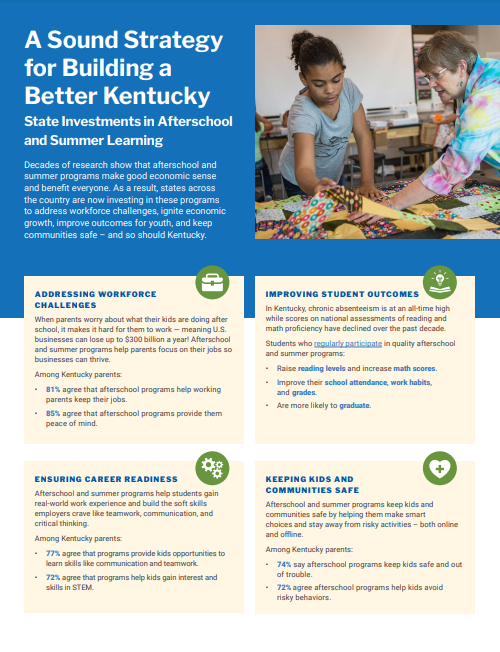
A Sound Strategy for Building a Better Kentucky: State Investments in Afterschool and Summer Learning
This February 2025 fact sheet from KYOSA highlights how other states are investing in afterschool and summer learning to address workforce challenges, ignite economic growth, improve outcomes for youth, and keep communities safe.
Out-of-School Time in Kentucky: Unmet Needs and Opportunities for the Future
Published by KYOSA in December 2020, our landmark study provides descriptive data on Kentucky’s out-of-school time (OST) landscape and details the state of public and private investment in OST programming for K-12 students across the Commonwealth.
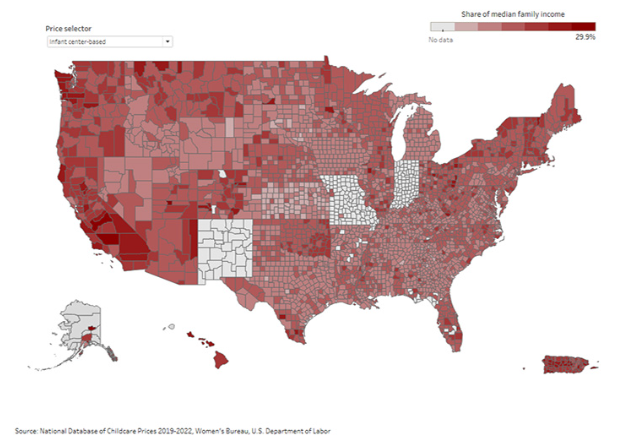
National Database of Childcare Prices
The National Database of Childcare Prices (NDCP) is the most comprehensive federal source of childcare prices at the county level, offering childcare price data by childcare provider type, age of children, and county characteristics.
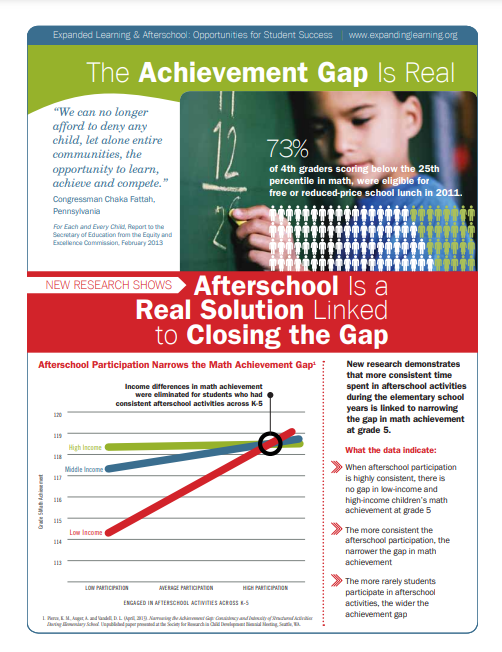
The Achievement Gap is Real
New research from Dr. Deborah Vandell, Chancellor’s Professor Emerita at the University of California Irvine School of Education, that demonstrates that when afterschool participation is highly consistent during the elementary years, the math achievement gap between low-income and high-income children is eliminated by grade 5.
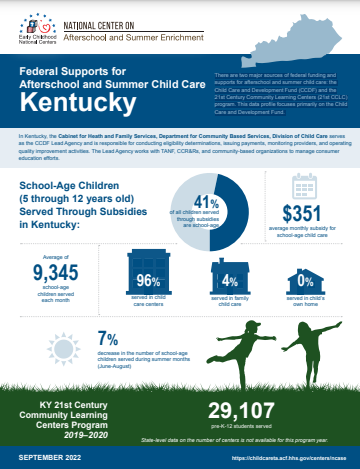
Federal Supports for Afterschool and Summer Child Care: Kentucky
This school-age data profile from the National Center on Afterschool and Summer Enrichment (NCASE) shows how many school-age children in Kentucky are served through CCDF and what CCDF policies and best practices are used in Kentucky to support school-age child care access and quality.

The Potential Need for and Use of Out-of-School Time Care for School-Age Children in 2012 and 2019
This snapshot from Child Trends describes the potential need for OST care for school-age children using the 2012 and 2019 National Survey of Early Care and Education (NSECE). The prevalence of out-of-school time care among different demographic groups is also examined.